
- OVERVIEW
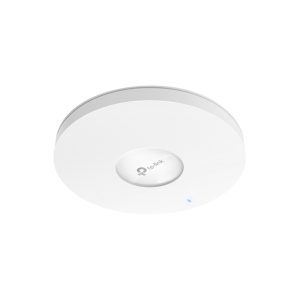
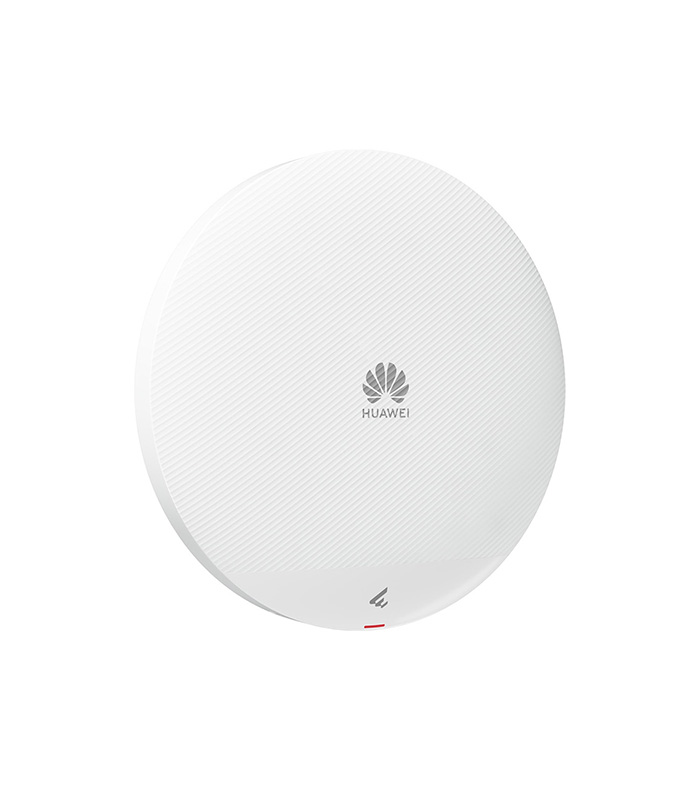
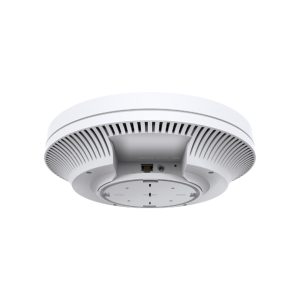
Huawei eKitEngine AP371 is a next-generation indoor access point (AP) in compliance with Wi-Fi 7(802.11be).
It can simultaneously provide services on 2.4 GHz (2×2 MIMO) and 5 GHz (2×2 MIMO) frequency bands, supporting a total of 4 spatial streams and achieving a device rate of up to 3.57 Gbps.
The AP is empowered by brand-new Wi-Fi 7 technologies and is equipped with built-in smart antennas to enable always-on Wi-Fi signals for users, significantly enhancing users’ wireless network experience.
Additionally, it has a compact size, facilitating flexible deployment and saving customer investment.
These strengths make the eKitEngine AP371 ideal for indoor coverage scenarios such as small- and mediumsized business (SMB) workplaces, hospitals, and shopping malls and supermarkets.
Wi-Fi 7 (802.11be) standard : Wi-Fi 7 (802.11be) is the next-generation Wi-Fi standard to be launched, also known as IEEE 802.11be or
extremely high throughput (EHT). Based on Wi-Fi 6, Wi-Fi 7 introduces technologies such as 320 MHz bandwidth, 4096-quadrature amplitude modulation (QAM), multi-resource unit (RU), multi-link operation (MLO), enhanced multi-user multiple-input multiple-output (MU-MIMO), and multi-AP coordination.
Drawing on these cutting-edge technologies, Wi-Fi 7 delivers a higher data transmission rate and lower latency than Wi-Fi 6. The network throughput of Wi-Fi 7 is expected to increase to more than 30 Gbps, about three times that of Wi-Fi 6.
Wi-Fi 7 vs. Wi-Fi 6 :Based on the Wi-Fi 6 standard, Wi-Fi 7 introduces a plurality of new technologies. The following compares Wi-Fi 6 and Wi-Fi 7.
New Features in Wi-Fi 7 :Wi-Fi 7 aims to increase the WLAN throughput to over 30 Gbps and provide low-latency access assurance.
To achieve this goal, the standard defines modifications to both the physical layer (PHY) and MAC layer.
Compared with Wi-Fi 6, Wi-Fi 7 brings
the following technical innovations:
Higher-Order 4096-QAM :The highest order modulation supported by Wi-Fi 6 is 1024-QAM, which allows each modulation symbol to carry up to 10 bits. To further improve the rate, Wi-Fi 7 introduces 4096-QAM so that each modulation symbol can carry 12 bits. With the same coding scheme, 4096-QAM in Wi-Fi 7 can achieve a 20% rate increase compared with 1024-QAM in Wi-Fi 6.
Multi-Link Mechanism : To efficiently utilize all available spectrum resources, the TGbe defines multi-link aggregation technologies, including the MAC architecture of enhanced multi-link aggregation, multi-link channel access, and multi-link transmission.
Multi-AP Coordination : In the current 802.11 protocol framework, there is not much coordination between APs. Common WLAN functions, such as automatic radio calibration and smart roaming, are vendor-defined features. Multi-AP coordination aims to optimize channel selection and adjust loads between APs to achieve efficient utilization and balanced allocation of radio resources.
Coordinated scheduling between multiple APs in Wi-Fi 7 involves inter-cell coordinated planning in the time and frequency domains, inter-cell interference coordination, and distributed MIMO.
This reduces interference between APs and greatly improves the utilization of air interface resources.
Wi-Fi 7 Application Scenarios :
New functions introduced by Wi-Fi 7 will significantly improve the data transmission rate and deliver lower latency.
These highlights will contribute to the development of emerging applications:
Video stream
Video/Voice conference
Online gaming
Real-time collaboration
Cloud/Edge computing
Industrial IoT
Immersive AR/VR
Interactive telemedicine
- Specifications:-
Installation Type :
Wall
Ceiling
T-Rail
Technical
Dimensions (diameter ×height)
180 mm x 35 mm (7.09 in. x 1.38 in.)
Weight with packaging [kg(lb)]: 0.69 kg (1.52 lb)
Port type :
1 x 100M/1GE/2.5GE electrical port
1 x USB port
LED indicator : Indicates the power-on, startup, running,alarm, and fault states of the system.
Wi-Fi standard:
2.4 GHz: 802.11b/g/n/ax/be
5 GHz:802.11a/n/ac/ac Wave 2/ax/be
Power
Power input:
DC: 12 V ± 10%
PoE power supply: in compliance with 802.3at/af
Maximum power consumption : 13.6 W (excluding USB)
Maximum heat dissipation [BTU/hour]: 44.1 BTU/hour
Maximum transmit power: 2.4 GHz: 20 dBm/chain 23 dBm (combined power) 5 GHz: 20 dBm/chain 23 dBm (combined power)
Power supply mode:
PoE
DC power adapter
Environmental
Operating temperature : –10°C to +50°C (14°F to 122°F)
Storage temperature: –40°C to +70°C (–40°F to +158°F)
Operating humidity : 5% to 95% (non-condensing)
Altitude: –60 m to +5000 m (–196.85 ft to +16404.20ft)
Atmospheric pressure : 53 kPa to 106 kPa
Ground: floating ground
Operating frequency band: 2.4GHz •5GHz
Radio
Antenna type : Built-in smart antennas
Antenna gain :
2.4 GHz: 4 dBi
5 GHz: 5 dBi
Maximum number of SSIDs on each radio : 10
Maximum transmit power:
2.4 GHz: 23 dBm (combined power)
5 GHz: 23 dBm (combined power)



6.0-L_normal_1578293286535f-300x300.jpg)